Scania's decarbonisation targets
Decarbonisation is the area where Scania can make the biggest contribution to sustainability. We have a plan to make that happen.
To manage our climate impact and mitigate risk, we are committed to reducing emissions throughout our entire value chain and across all relevant scopes.
We focus on our material impacts in three key areas: Operational emissions (scope 1 and 2), vehicle-in-use emissions (scope 3) and supply chain emissions.
Our decarbonisation journey is supported by a suite of near-term and long-term decarbonisation targets and commitments across our full value chain.
Science-based climate targets
In 2020, we adopted science-based climate targets. We wanted not only to hold ourselves accountable, but also to set an example and inspire change across our sector. Our aim was to demonstrate that we had the technology, products, and strategies necessary to reduce CO2 emissions across our value chain, in line with scientific recommendations.
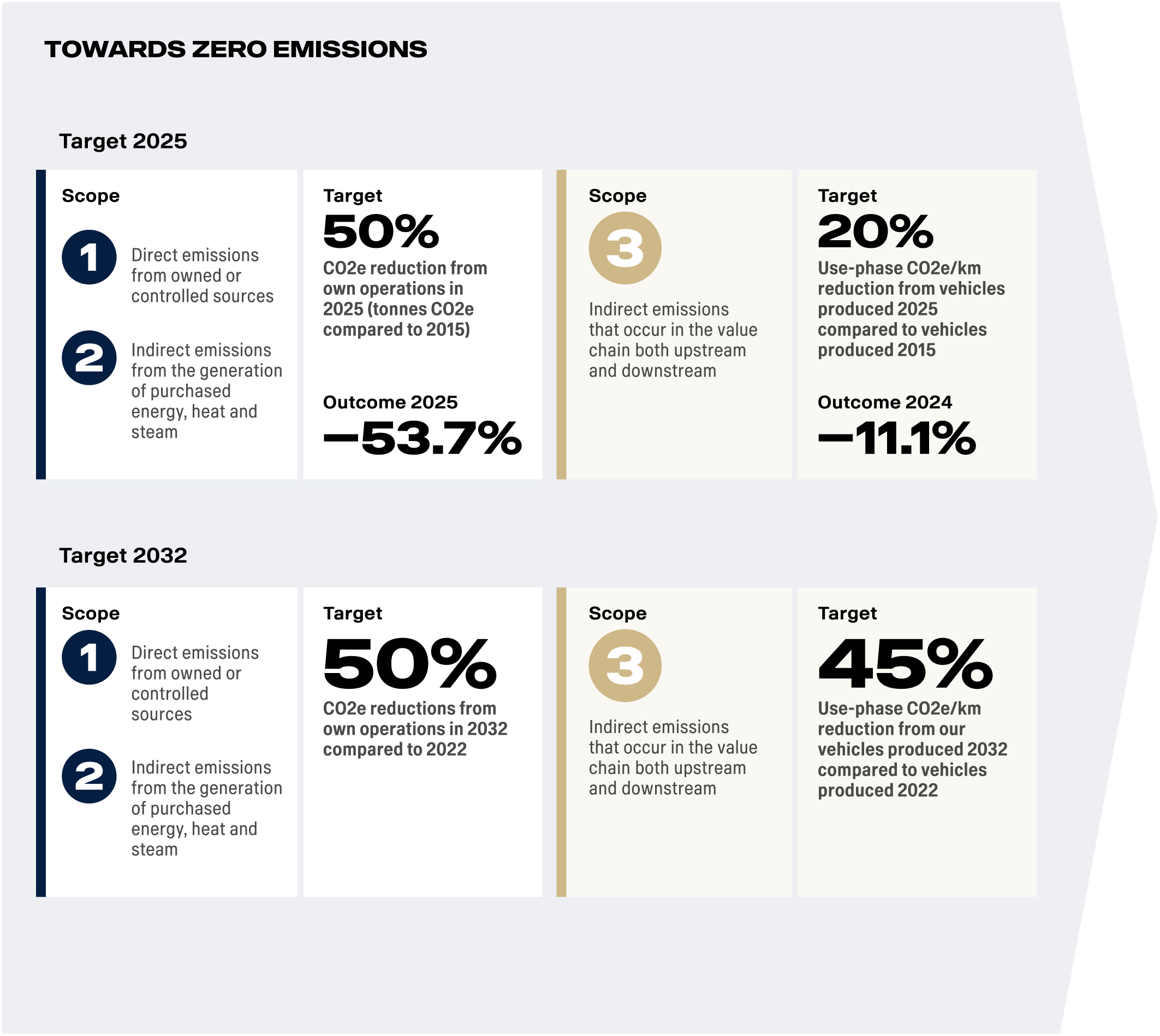
By 2025, our aim was to reduce emissions from our operations by 50 percent and the emission intensity of vehicles sold by 20 percent, compared to 2015. While we reached the target for our own operations, we need to accelerate the reduction of emissions from vehicles sold, where most emissions occur.
We will continue to drive this transformation with urgency. At the same time, the speed and scale of the shift depend on enabling conditions such as charging infrastructure and effective policy instruments. As we move forward, strong and predictable support from policymakers will be essential to unlock the full potential of sustainable transport.
Click to enlarge
Near term targets 2032
Although our forecast shows that we are unlikely to achieve our vehicles in use emissions target by 2025, it is still estimated that we will progress and tighten the gap.
In the longer term, our commitment to reducing emissions in line with science has not wavered. To achieve this we have introduced new interim targets for 2022-2032, committing us to halving emissions every decade.
Our operations
Our operational carbon footprint includes the running of company assets such as our industrial and commercial facilities and our use of company vehicles (scope 1), as well as the energy we use for heating and cooling (scope 2). Decarbonisation activities include switching to renewable energy for our facilities and using electric vehicles for our transport needs.
In addition to our target to reduce operational emissions by 50 percent until 2032, we have supporting targets covering energy and use of fossil free electricity.
Ambitions for our supply chain
Upstream supply chain emissions include both emissions from the production of materials and components, as well as emissions from transports of materials andfinished products. The production of materials accounts for the largest share of supply chain emissions. Scania has identified four material-related emission hotspots: steel, batteries, aluminium and cast iron.
In 2022, across our European operations, Scania set an ambition to purchase 100 percent green steel, batteries, aluminum and cast iron by 2030. Green is defined as the reduction of the main emission source through use of new technologies, fossil free electricity and/or recycled materials. In batteries, for example, access to green energy in production is crucial. In flat steel production, replacing coal with green hydrogen is key.
Scania is consistently reviewing our ambitions based on scientific evidence, market development, technological advancements and availability of materials. We are conscious that supply chain readiness for green batteries, components and materials remains a critical dependency for realising our ambition.