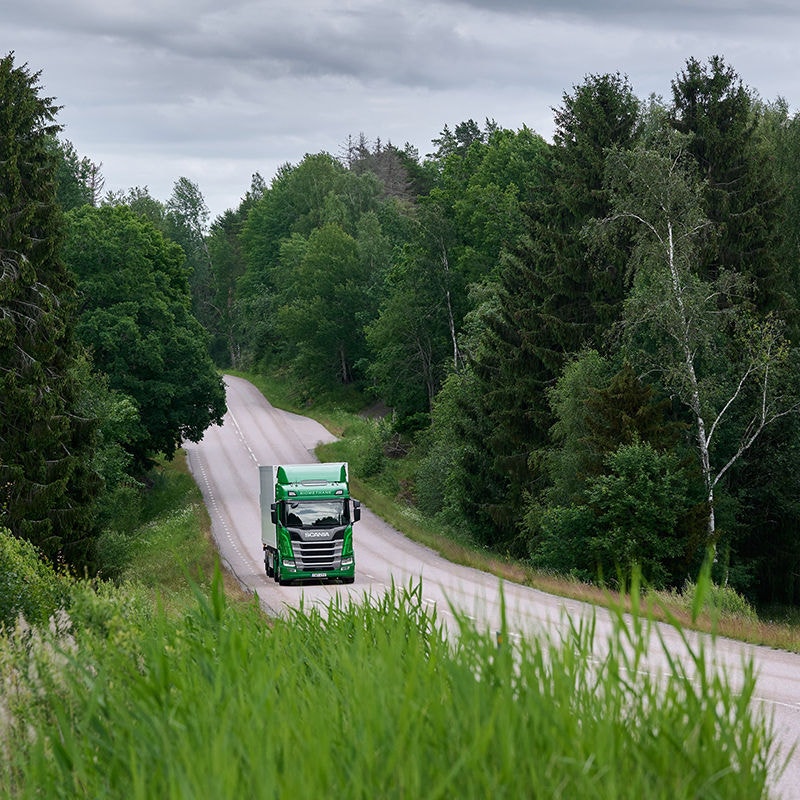
Scania supports transport companies across the world by delivering heavy trucks for each customer’s need. We offer solutions for a range of different applications including long-distance, urban applications and construction.
Renewable fuels
Benefits with renewable fuels
Biofuels are often a both cost and CO2 efficient solution – and sometimes the only viable option for some transport applications and markets.
Renewable fuels can play a role in reducing greenhouse gas emissions from heavy transport. Alongside improved fuel efficiency and electrification, they may provide an alternative for some transport applications, including vehicles already in operation.
Scania offers engines and vehicles designed to operate with selected alternative fuels, including hydrotreated vegetable oil (HVO), biodiesel (FAME) and biomethane, depending on the vehicle and engine specification.
The suitability of each fuel depends on technical compatibility, fuel quality and local availability. In New Zealand, customers should confirm the availability of the relevant fuel and its approval for their Scania vehicle before use.
Renewable fuels can contribute to lower lifecycle greenhouse gas emissions compared with fossil diesel. The potential reduction varies according to the fuel's feedstock, production pathway and use. The actual benefit for New Zealand operators will depend on the fuel supplied and the operating application.
CO2 reduction figures for transport
The potential CO₂ reduction from alternative fuels and powertrains varies according to the fuel or energy source, production methods, vehicle specification and operating conditions.
Lifecycle emissions are commonly assessed using a well-to-wheel approach, which considers emissions associated with producing and supplying the energy as well as using it in the vehicle.
Scania's published CO₂ reduction figures are based on specified reference conditions and should not be interpreted as guaranteed reductions for every fuel, vehicle or market. Actual results for New Zealand operations will depend on the energy source and the specific application.
Renewable fuels for today and tomorrow
Choosing the right transport solution depends on the needs of your business, the vehicle application and the options available in your market.
Scania's range includes vehicles and powertrain technologies designed for different transport requirements. Where alternative fuels are being considered, fuel availability, vehicle compatibility and the potential emissions benefits should all be assessed before making a decision.
Hydrotreated Vegetable Oil (HVO)
HVO is a renewable diesel alternative produced from suitable feedstocks, including waste oils and animal fats. Its potential greenhouse gas benefits depend on the feedstock and production process.
Compatibility depends on the specific vehicle and fuel specification. Before using HVO in New Zealand, customers should confirm local supply, applicable fuel requirements and approval for their Scania vehicle.
Biodiesel (FAME)
Biodiesel, also known as fatty acid methyl ester (FAME), can be produced from vegetable oils, used cooking oil and other suitable feedstocks. It can reduce lifecycle greenhouse gas emissions compared with fossil diesel, depending on how it is produced.
The suitability of biodiesel depends on fuel quality, blend concentration and vehicle specifications. Customers should confirm the approved fuel and blend for their Scania vehicle before use.
Battery Electric Vehicle (BEV)
Scania battery-electric vehicles offer an alternative to conventional combustion-engine vehicles for suitable transport applications. Their potential environmental benefits depend on factors including the electricity source, vehicle specification and operating conditions.
Explore Scania's electric truck range and charging considerations for your operation.