


A sustainable transport system
A sustainable transport system is one that meets the needs of planet, people and business. The shift to a sustainable transport system is underway and Scania is taking a leading role in driving it.
Transport is a major contributor of CO2 emissions, and is also responsible for air pollution, traffic congestion and road accidents. Also, the system is not inclusive – not everyone has access to efficient transport. We need a sustainable transport system: one that retains the benefits of transport and makes it accessible to more people, while reducing the negative impacts or avoiding them altogether, in line with the UN’s sustainable development goals.
The definition of a sustainable transport system
Inclusive
Transport should be accessible to all, including users for whom access to current transport systems may be restricted for any reason. Transport solutions should also be designed for equality of access when it comes to gender.
Safe
Transport should be safe not only for drivers and transport users but also all other road users, including pedestrians, cyclists and other road vehicles. The concept of safety should extend beyond physical safety and if a transport solution is either unsafe for certain groups to use, or perceived to be so, it is not accessible to all.
Decarbonised
For the transport system to be sustainable, it must be decarbonised. This involves breaking the system’s dependency on fossil fuels by transitioning to electrification, the key pathway to a fully decarbonised transport system in the long term, supported by renewable fuels. Decarbonising transport at the speed and scale required by the Paris Agreement demands rapid and widespread changes in both transport and energy systems – a shift that calls for bold, coordinated action across the entire transport ecosystem.
Healthy and clean
Transport solutions should be clean and minimise harm to health. Less polluting vehicles contribute to a cleaner environment, with less nitrogen oxide, sulphur oxide and soot particles, particularly in urban areas. Sustainable transport can also contribute to mental health by alleviating stress and other conditions associated with traffic noise, congestion and overcrowding.
Efficient
Transport systems must evolve for productivity. End-to-end logistics still have waste. With better energy efficiency and real-time data, transport flows can be optimized. Routes planned and load capacity increased. Product and service specifications refined to minimize resources for moving goods and people.
Our sustainability focus areas
Scania is a global company working on five continents, with customers in more than 100 countries. Every day, our operations and products impact millions of people, both directly and indirectly. For Scania, being a responsible business means understanding and managing these impacts across every stage in our value chain, from the way we source materials all the way through to the end-of-life phase of our products.
Scania’s corporate focus areas for sustainability in the coming decade are defined by our social and environmental impact and in dialogue with our stakeholders.
As part of Scania’s business strategy, we have set three priority areas where we must deliver in order to operate sustainably in the future: decarbonisation, social sustainability and circular business.
Decarbonisation
Rapidly transitioning away from fossil fuels.
Ending heavy transport’s reliance on fossil fuels is our sector’s – and Scania’s – most urgent challenge. And it is achievable. We are convinced that transport can be decarbonised by 2050, in line with the Paris Agreement. Our own decarbonisation targets are aligned with that goal.

Social sustainability
Ensuring a just transition for people and society.
The transformation of the transport industry affects people everywhere. For Scania, social sustainability means taking responsibility for people. That includes the people who work at Scania, the people who work for our suppliers and the people whose lives are affected by our products and operations.
Circular business
Optimising the use of resources and minimising waste throughout the product life cycle.
Our industry is learning that good business means producing better, not more. At Scania, we aim for decoupling business growth from resource use, adopting a circular economic model where use of existing resources is maximised and waste is minimised across the value chain.

Sustainable transport solutions
From custom solutions to trusted support, Scania helps your business cut emissions and navigate the shift to sustainable, profitable transport.
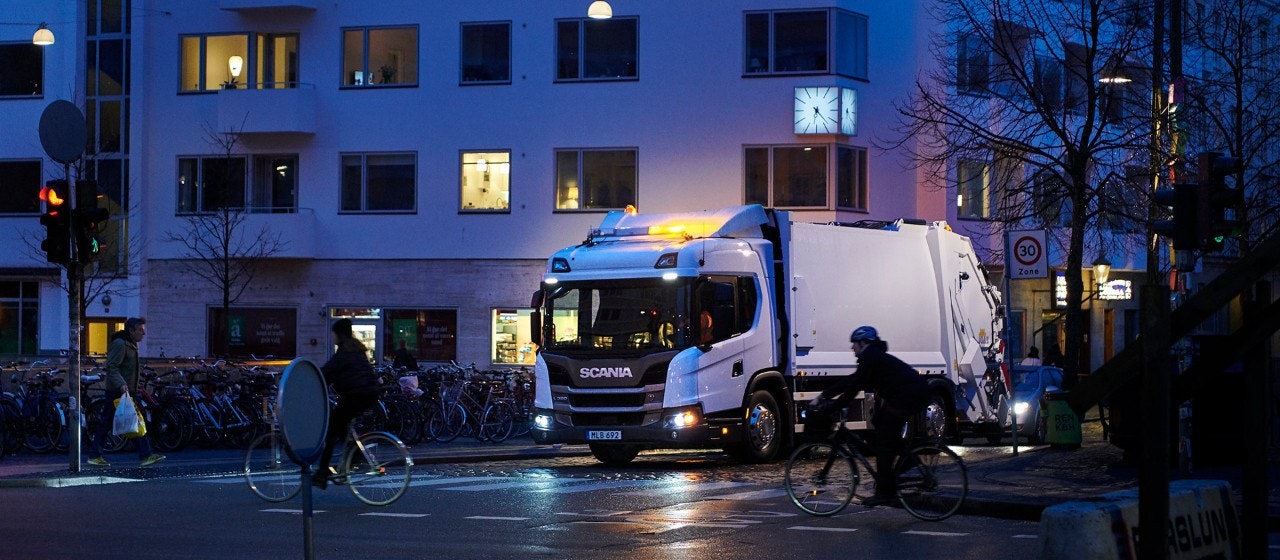
Sustainable transport starts with safety
Scania’s advanced safety systems protect drivers, passengers, and other road users through intelligent design and innovation—supporting a safer transport ecosystem with long-term efficiency in mind.
Scania Sustainability Statement
Scania presents the Scania Sustainability Statement in accordance with the European Sustainability Reporting Standards (ESRS).